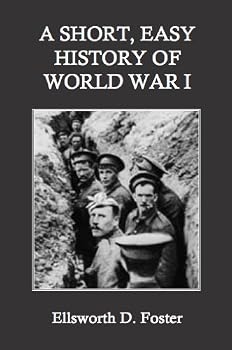

This easy-to-understand history of World War I (equivalent in length to a physical book of approximately 75 pages), was written just one year after the Great War ended, especially for the multi-volume “World Book: Organized Knowledge in Story and Picture,” by the Editor of that esteemed reference work.
CONTENTS
Causes of the War
The Beginning of the Conflict
The Battle Fronts
Land Operations to the End of 1915
Events on Land in 1916
Events on Land in 1917
War on the Sea
The War in the Air
Submarines in the War
The United States in the War
The Final Stages and the Peace Settlement
sample passage:
President Wilson was loath to commit the United States to a part in the titanic struggle, though there is evidence that for many months he foresaw the inevitable. Early in 1916 he stated in a public address that the world was on fire and the sparks were falling dangerously near the republic; he asked his auditors, “Are you ready for the test?” That he felt militant action would not be endorsed at the time is evident. He had kept the nation out of war, for which the people were grateful, and largely on that issue he was re-elected President. But the inexorable logic of the situation speedily forced an unprepared country to bear its share of the burden of defending the world against aggression.
On April 2, 1917, at the call of the President, the Congress of the United States met in special session to consider the grave situation. The central figure in one of the most dramatic scenes in the history of the nation, President Wilson stood before Congress and told of his labors to maintain the peace; of the pledges given and broken by the power the nation was destined to assail; of the daring affronts of its diplomatic agents; of the plots against the security of the republic and of the certainty that patience could no longer be exercised. He did not ask for a declaration of war against the German Empire, but declared that on the part of Germany there had been virtual war against the republic for many months. Rather, he asked Congress to declare that a state of war existed, to the end that the United Slates might help “make the world safe for democracy.”
About the Author:
Ellsworth D. Foster (1869-1936) was the Editor of “World Book: Organized Knowledge in Story and Picture” and the author of “Cyclopedia of Civil Government.”
DOWNLOAD A SHORT. EASY HISTORY OF WORLD WAR I - ELLSWORTH D. FOSTER

No comments:
Post a Comment